Friday, May 18, 2012

Short-Story Month 2012: Day 18, The Tell-Tale Heart by Edgar Allan Poe

It is Day 18 of National Short-Story Month, and who better than Edgar Allan Poe for such a day?  Here is the first story she ever read by him, "The Tell-Tale Heart" (although she read it in fourth grade in a collection adapted for children, and at that time, she didn't know what "adapted" meant and was quite irritated to find out, once she did, that it meant she hadn't actually read the story as it was meant to be).

The following newspaper article is the original publication of "The Tell-Tale Heart" (January 11, 1843), and it comes from the Edgar Allan Poe Digital Collection virtually located at the University of Texas at Austin-Harry Ransom Center.


by Edgar Allan Poe
(1843)


The New York Sun. [From the Pioneers.] The Tell-Tale Heart. By Edgar A. Poe. Art is long and Time is fleeting, And our hearts though stout and brave, Still, like muffled drums, are beating Funeral marches to the grave. [Longfellow.  Then text of story begins.
Original newspaper for The Tell-Tale Heart,
The New York Sun 1/9/1843. For larger version, go here 

Thursday, May 17, 2012

Short-Story Month 2012: Day 17, Old Lady Lloyd by L.M. Montgomery

"The children believed she amused herself counting the gold in the big black box under her bed. Spencervale children children held the old lady in mortal terror; some of them--the "Spencer Road" fry--believed she was a witch [.  . .]" 

Illustration of fictional character Anne Shirley from L.M. Montgomery's book Chronicles of Avonlea
From Chronicles of Avonlea,
character Anne Shirley
It's Day 17 of National Short-Story Month.  Until today, every selected story has been by a United States author.  Today's selection, however, if from the United States' close relation, Canada.


L.M. Montgomery's story collection, Chronicles of Avonlea, follows the place, people, and the main character Anne Shirley, from Montgomery's popular series Anne of Green Gables. By this time, Anne Shirley is a young woman; however, knowledge of Anne Shirley's past is not necessary to enjoying these works.  Most, if not all, the characters are not from the original series.


It has seemed to her every time she had read any of Montgomery's work, whether at age 12 or 30, that Montgomery is a superior writer at, especially, the crafting of landscapes.  It is somewhat easy to have a reader imagine, let's say, an orchard.  But it is something quite other to walk the reader through the orchard as another person.  But Montgomery can do that, and does that consistently.  It is a beautiful world L.M. Montgomery gives us.  

There is a fragile lightness and cheer and underlying wish for goodness that comes beneath Montgomery's work, but that does not come from, for example, a negligence of the desperation of humankind.  No, Montgomery does not have a sort of Pollyanna-with-closed-eyes perspective but seems almost constantly aware of the precipice, and it is that that enriches her work.  

But we can save what she might think about Montgomery's work for another day.  Today we must read the story "Old Lady Lloyd", and celebrate that such a work and writer should be in the world.      


by L.M. Montgomery
(1912)


Spencervale gossip always said that "Old Lady Lloyd" was rich and mean and proud. Gossip, as usual, was one-third right and two-thirds wrong. old Lady Lloyd was neither rich nor mean; in reality she was pitifully poor--so poor that "Crooked Jack" Spencer, who dug her garden and c hopped her wood for her, was opulent by contrast; for he, at least, never lacked three meals a day, and the Old Lady could sometimes achieve no more than one. But she was very proud--so proud that she would have died rather than let the Spencervale people, among whom she had queened it in her youth, suspect how poor she was and to what straits was somtimes reduced. She much preferred to have them think her miserly and odd--a queer old recluse who never went anywhere, even to church, and who paid the smallest subscription to the minister's salary of anyone in the congregation.
Text for Our Lady Lloyd by L.M. Montgomery

Wednesday, May 16, 2012

Short-Story Month 2012: Day 16, Of Missing Persons by Jack Finney

Walk in as though it were an ordinary travel bureau, 
the stranger I’d met at a bar had told me. Ask a few
ordinary questions—about a trip you’re planning, a 
vacation, anything like that. Then hint about The Folder
a little, but whatever you do, don’t mention it directly; 
wait till he brings it up himself. And if he doesn’t, you 
might as well forget it. If you can.

Until today, each story selected in celebration of National Short Story Month has been published online, and as such, each post has linked to where that story exists on the vast web.  However, today's selection cannot be found online (outside of a copyright-infringed version), but it should be singled out, regardless.

She originally read "Of Missing Persons" in the anthology, Stories of Suspense.  It's a story well worth checking out--a sort of time-travel story that begins in a city, in an anonymous store. The story appears in his collection, About Time: 12 Short Stories.

From here


"Of Missing Persons"
by Jack Finney
(1955)


Tuesday, May 15, 2012

Short-Story Month 2012: Day 15, Perhaps Ernest Hemingway

According to Snopes.com, it has not been determined whether or not the famous six-word story attributed to Ernest Hemingway was actually written by Hemingway.  Regardless of the story's author, that's today's selection for National Short Story Month:


For Sale: baby shoes, never worn


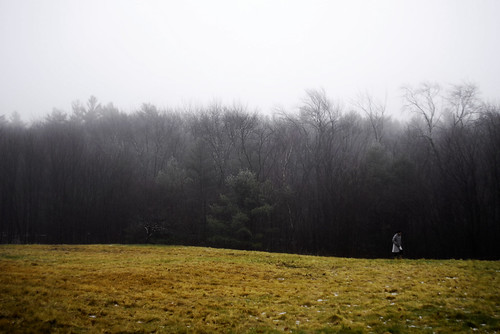
Photograph of woman alone in field flanked by forest
Used under CC license


Monday, May 14, 2012

Short-Story Month 2012: Day 14, Hands by Sherwood Anderson


Sherwood Anderson
It's a new week and the midpoint of celebrating National Short Story Month.  And so, today's selection is a story from the Midwest, and from one of the most remarkable short-story collections written or published in the United States.   


"The story of Wing Biddlebaum is a story of hands. Their restless activity, like unto the beating of the wings of an imprisoned bird, had given him his name. Some obscure poet of the town had thought of it. The hands alarmed their owner."


"Hands" by Sherwood Anderson
from his story collection Winesburg, Ohio (1919)

Sunday, May 13, 2012

Short-Story Month 2012: Day 13, Where Are You Going, Where Have You Been? by Joyce Carol Oates

"He wagged a finger and laughed and said,
 'Gonna get you, baby'" [. . .]" 


Perhaps the story for Day 13 should be 
Little Red Riding Hood in order to set 
the mood for what might have been 
tomorrow's story, but instead, here's 
what she would call a contemporary 
retelling of that folktale by Joyce Carol Oates, 
"Where Are You Going, Where Have you Been?"


In Video: Joyce Carol Oates talks about
"Where Are You Going, Where Have You Been?"
(2:02 runtime)


by Joyce Carol Oates
(1966)


(For those  Joyce Carol Oates fans interested in seeing some of Oates's original manuscript pages  for her other stories, please visit the virtual archive at University of San Francisco. Also, if you missed Oates's winning of the 1990 Rea award for short fiction, see the NYT article.)


Saturday, May 12, 2012

Short-Story Month 2012: Day 12, Young Goodman Brown by Nathaniel Hawthorne

"Faith kept me back a while," 
replied the young man, with a tremor in his voice, 
caused by the sudden appearance of his companion, 
although not wholly unexpected.


"Trees in the Fog" by Matthew Bietz,
Used under CC license

Yesterday's selection, "The Red Bow" by George Saunders, has always reminded me of one of my favorite stories.  And so to celebrate the twelfth day of National Short Story Month, please enjoy 

by Nathaniel Hawthorne 
(1835)  


Young Goodman Brown.  Young Goodman Brown came forth at sunset, into the street of Salem village, but put his head back, after crossing the threshold, to exhange a parting kiss with his young wife. And Faith, as the wife was aptly named, thrust her own pretty head into the street, letting the wind play with the pink ribbons of her cap, while she called to Goodman Brown.


Continue Reading